
Carre et Bipartition de Graphe
图的平方(G²)
定义
对于一个图 G = (V, E),它的平方图 G² 是一个具有相同顶点集 V 的新图,其中:
- 如果
u和v在原图G中的最短路径距离d_G(u, v) ≤ 2,则在G²中添加一条边(u, v)。
换句话说,在平方图中,原图中相邻的顶点仍然相邻,且所有原图中距离为 2 的顶点在平方图中会直接相连。
数学表示
设原图 G 的邻接矩阵为 A,则平方图 G² 的邻接矩阵 A² 可以通过矩阵乘法计算:A² = A + A²
其中:
A是原图的邻接矩阵,A²计算了两步可达的顶点对。A²的非零元素表示原图中两步可达的顶点,它们会在平方图中直接相连。
下面分别对MatAdj和ListeAdj两种图的结构实现图的平方:
MatAdj
1 | MatAdj carre_MA(MatAdj g) { |
ListeAdj
1 | // 检查链表中是否存在某个元素t |
测试函数
1 |
|
Bipartition
判断一个图是否是二分图
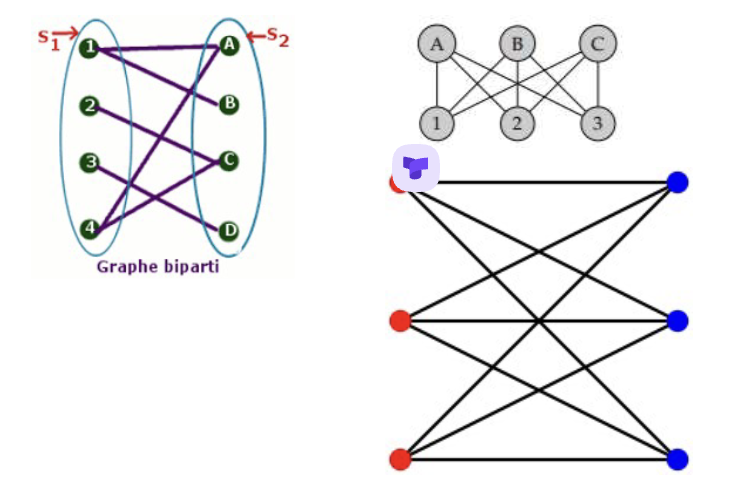
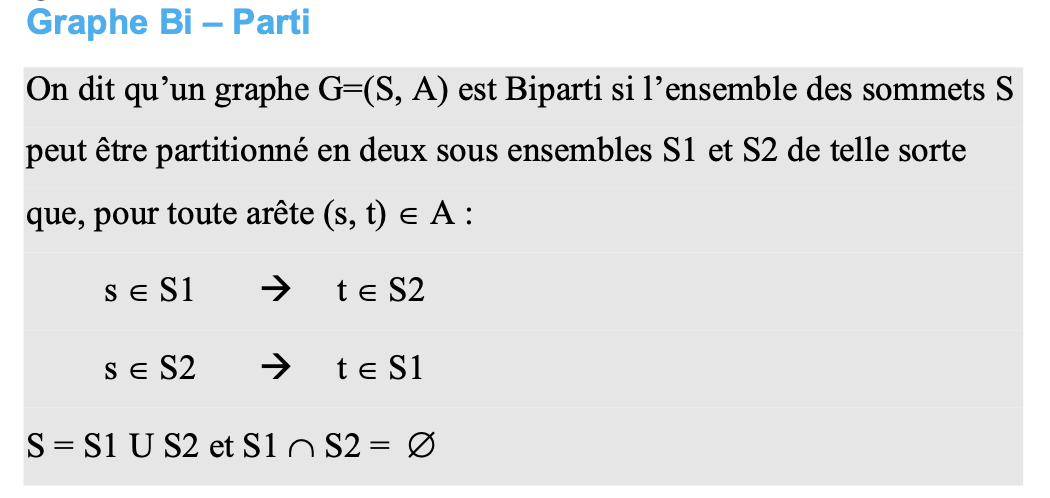
C语言实现
1 |
|
测试函数
1 |
|
本博客所有文章除特别声明外,均采用 CC BY-NC-SA 4.0 许可协议。转载请注明来源 Elie Blog!
 Wechat
 Alipay
相关推荐

2025-03-02
Connexe de Matrices
Composants Connexes找连通分量(通过深度、广度搜索) 伪代码123456789101112131415161718192021222324252627//找连通分量procédure ComposantesConnexes(Graphe g)Début //Initialisation n ← nbSom(g) visite ← allocTab(n) pour chaque sommet s variant de 1 à n faire visite[s] ← faux finPour s ← 1 nbSomVisite ← 0 finParcours ← faux //Traitement Tantque non finParcours faire reParcoursProfondeur(s, visite, g, nbSomVisite, ....) //A modifier // itParcoursProfondeur(s, visite, g,...
2025-03-02
Fermeture Transitive
Fermeture Transitive d’un Graphe (传递闭包)图的传递闭包(Transitive Closure) 主要用于描述图中**可达性(reachability)**的关系。 给定一个有向图 G = (V, E) ,其传递闭包 G* 是一个新的图,其中:若 从顶点 u 可以通过某条路径到达 v,那么在 G* 中, (u, v) 之间直接有一条边。即:若 u 能通过 1 条或多条边到达 v ,则在传递闭包中直接连接 u 和 v。 Warshall算法Warshall 算法简介算法概述Warshall 算法用于计算有向图的传递闭包,即判断图中哪些顶点是可达的。它是 Floyd-Warshall 算法 的一种特例,专门用于可达性问题。 算法思想对于一个有向图的 邻接矩阵 A,如果存在路径 从顶点 i 到 j,则在 传递闭包矩阵 T 中,T[i][j] 置为 1。算法通过动态规划逐步更新可达性信息。 算法步骤 初始化:将原始邻接矩阵 A 作为可达性矩阵 T。 逐步加入中间点 k: 如果从 i 到 k 可达,且从 k 到 j 可达,那么...
2025-02-22
Graphe_Matrices
Matrice d‘incidence(关联矩阵)Matrice d’incidence sommets-Arcs(有向图)定义(顶点-弧的关联矩阵)在图论中,关联矩阵(Matrice d’incidence) 是一种描述图中顶点与边(或弧)之间关系的矩阵。定义: 顶点-弧关联矩阵是一个矩阵,用于表示图中每个顶点与每个弧之间的关系。对于一个有向图或无向图的每个弧,矩阵中包含表示该弧和顶点之间的关联信息。 假设图有 n 个顶点和 m 条弧(边),则顶点-弧关联矩阵是一个 n \times m 的矩阵,其中: 每一行代表一个顶点(1,2,3,4) 每一列代表一个弧(或边)(a1,a2,a3…) 结构:123456typedef struct { int nbSom; //顶点数量(矩阵行数) int nbAcs; //弧数量(矩阵列数) int **mat; //二维数组用于存矩阵数据(-1,,0,1) //TCout **cout; //二维数组用于储存权重数据}MatIncidente; Matrice...
2025-03-01
Parcours de Graphe
ParcoursProfondeur对三种数据结构(MatAdj,ListeAdj,FS)的图进行递归和迭代两种方法的深度优先遍历(DFS)。 12345678910111213141516171819202122#include <stdio.h>#include <stdlib.h>#include "../structGraphe.h"//根据visite数组,返回下一个sommetint somSuivant(int s, int n, int *visite) { for (int i = s + 1; i < n; i++) { // 从 s+1 开始找 if (!visite[i]) { // 发现未访问的节点 return i; } } // 如果没有找到,则从头开始找 for (int i = 0; i < s; i++) { ...
2025-03-01
Opération de Matrices
Opération de MatriceOn considère un graphe orienté G=(S, A) qui peut être représenté selon l’une des structures suivantes : Une matrice d’adjacence. Une liste d’adjacence. Une file des successeurs. Pour chaque type de représentation, écrire les algorithmes suivants : Détermination des successeurs找出给定顶点的所有后继顶点 MatAdj123456789void somSucc1(int s, MatAdj m) { int n = m.nbSom; //顶点数量 for (int i = 0; i < n; i++) { if (m.mat[s][i] == 1) { //...
2025-02-22
Graphe基础知识
Graphe non orientéG = (S,A) 连通(connexité)在无向图中,顶点v到顶点w之间有路径存在,则称v和w是连通的 连通图(Graphe connexe)若图G中任意两个顶点之间都直接或间接连通,则称图G为连通图,否则为非连通图 连通分量(Composante connexe)无向图中的极大连通子图称为连通分量 Graphe orientéG = (S,A) On note l’arc (s,t)par s->t 强连通(forte connexité)在有向图中,如果有一对顶点v和w,从v到w和w到v之间都有路径,则称这两个顶点是强连通的 强连通图(Graphe forte connexité)若有向图G中任意一对顶点都是强连通的,则称图G为强连通图 强连通分量(Composante fortement connexe (CFC))有向图中的极大强连通子图称为有向图的强连通分量 ###完全图 graphe valuéG = (S,A,C) ordre d’un graphe (图的阶数)Le nombre de sommets d’un...
评论